
As an Amazon Associate, Espressora earns from qualifying purchases. We research published manufacturer specifications so you can compare grinders on facts, not marketing.
Ask any experienced home barista what matters most in an espresso setup and most will say the grinder — before the machine. Espresso demands a fine, consistent grind, and only burr grinders (never blade grinders) can deliver it. But once you start shopping, you hit the first fork in the road: conical burrs or flat burrs?
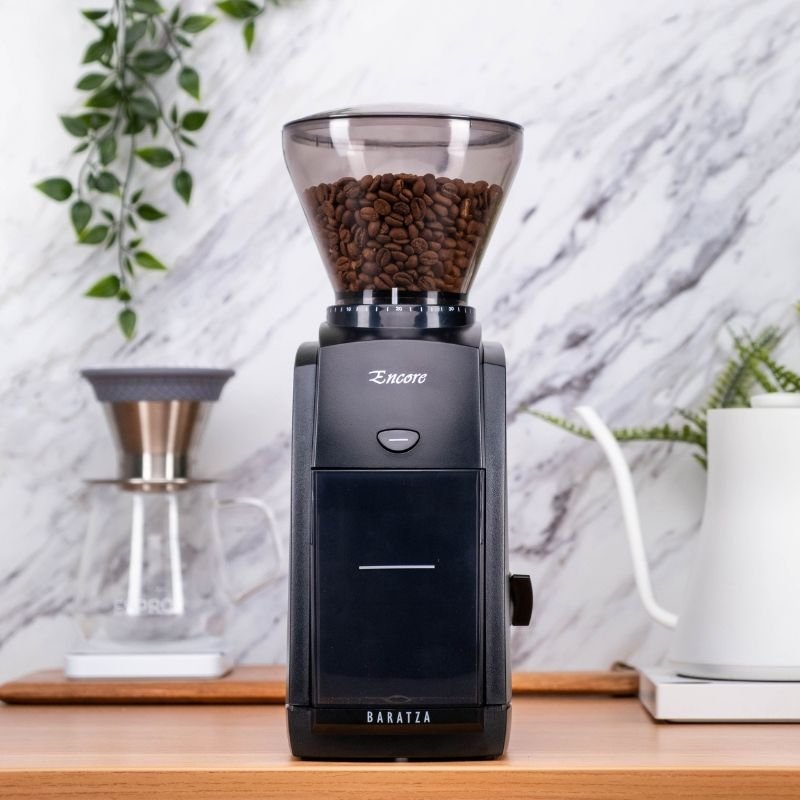
This guide explains what each burr geometry actually changes, with published specs from two representative grinders: the Baratza Encore ESP (conical) and the Eureka Mignon Specialita (flat).
How Burr Geometry Works
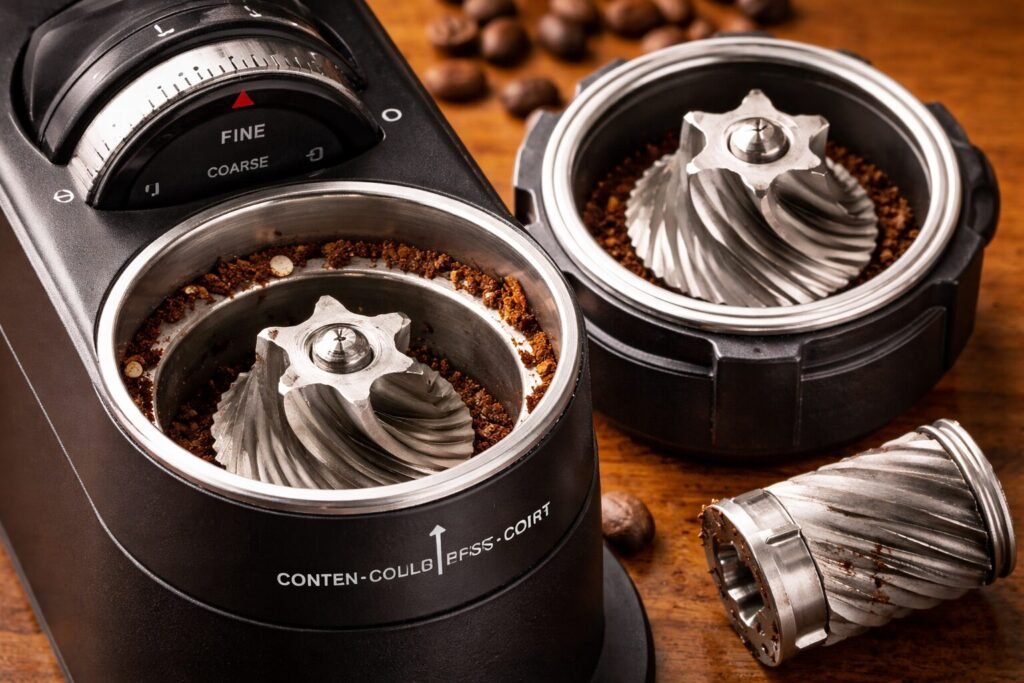
Conical burrs use a cone-shaped inner burr nested inside a ring-shaped outer burr. Coffee feeds downward by gravity, which makes conical sets relatively forgiving: they tend to produce fewer fines at coarse settings and run at lower RPMs with less heat.
Flat burrs use two parallel discs with angled teeth. Beans enter the center and are flung outward by centrifugal force. Flat burrs generally produce a more uniform particle distribution at fine settings — the reason many espresso-focused grinders use them — but they typically spin faster and can generate more heat and static.
In practice, burr size and alignment matter at least as much as geometry. A well-aligned 40mm conical set will outperform a poorly aligned 55mm flat set. Treat geometry as one factor among several, not the whole story.
Conical Example: Baratza Encore ESP
Baratza’s published specs for the Encore ESP list 40mm M2 conical steel burrs (manufactured by Etzinger in Liechtenstein), 40 stepped grind settings with a dual-range system — settings 1–20 reserved for espresso, 21–40 for filter brewing. Burr speed is 550 RPM, grind throughput runs 1.3 to 2.2 grams per second, and the hopper holds 230 grams. Power draw is 70W at 110–120V, and Baratza backs it with a 1-year warranty.
Notable design points: a quick-release burr mount for tool-free cleaning, a pulse button plus on/off knob (no timer), and an included dosing cup with a 58mm adapter. Baratza explicitly positions the ESP as the espresso-capable member of the Encore line — the standard Encore is not recommended for espresso, per the manufacturer.
Flat Example: Eureka Mignon Specialita
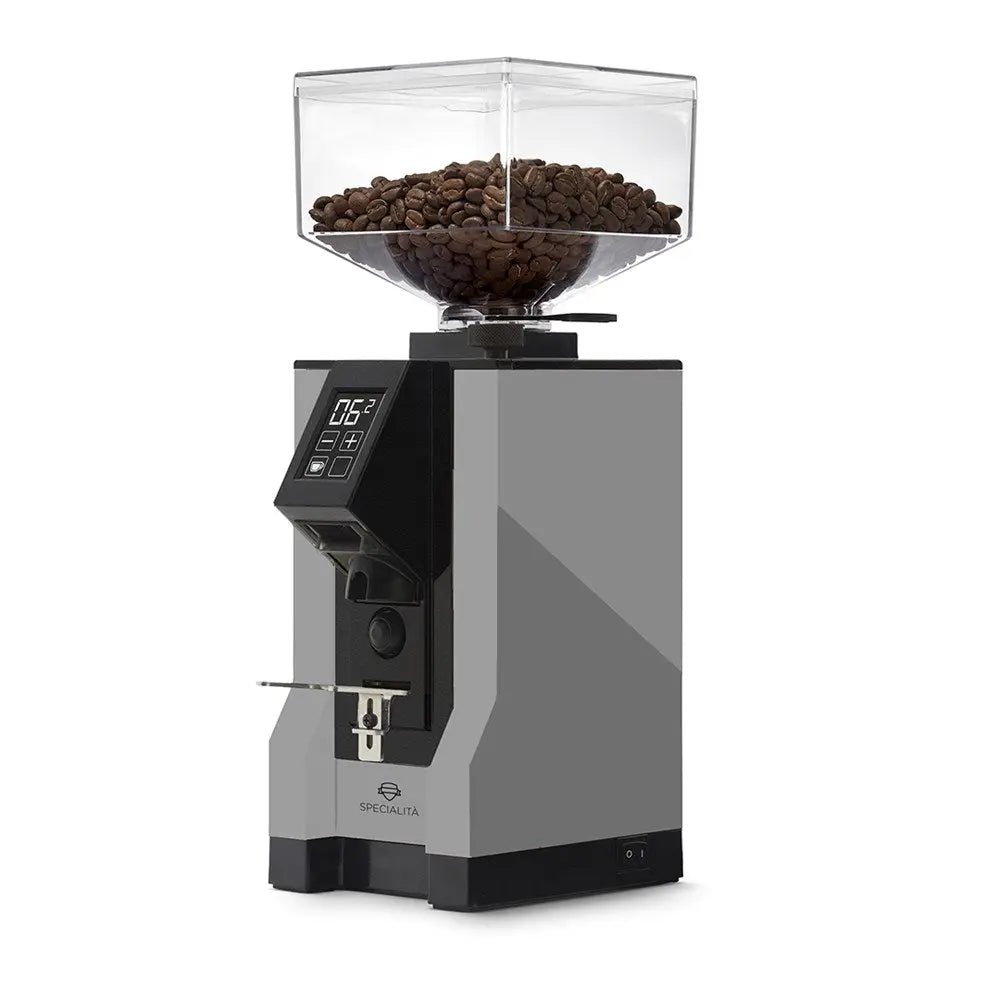
Eureka’s published specs for the Mignon Specialita list 55mm flat hardened-steel burrs, a stepless micrometric adjustment (infinite settings rather than clicks), and a 1350 RPM direct-drive motor. Grind throughput is rated at 1.4–1.8 g/s for espresso. The touchscreen offers two programmable timed doses plus manual mode, the hopper holds 300 grams, and the ACE anti-clump system addresses static. Dimensions are 4.72 × 7.1 × 13.78 inches at 12.35 pounds, and it is made in Italy.
The headline differences vs. the Encore ESP: larger flat burrs, stepless adjustment for finer dial-in control, timed dosing, and a roughly 4x heavier build — at a correspondingly higher price.
Side-by-Side: Published Specs
| Spec | Baratza Encore ESP | Eureka Mignon Specialita |
|---|---|---|
| Burr type / size | 40mm conical steel | 55mm flat hardened steel |
| Adjustment | 40 stepped settings (1–20 espresso) | Stepless micrometric |
| Burr speed | 550 RPM | 1350 RPM |
| Throughput | 1.3–2.2 g/s | 1.4–1.8 g/s (espresso) |
| Hopper | 230 g | 300 g |
| Dosing | Manual (pulse / on-off) | Touchscreen, 2 timed doses + manual |
| Power | 70W | 260–310W |
| Weight | ~7 lbs | 12.35 lbs |
| Made in | Designed USA, assembled Taiwan | Italy |
Which Should You Choose?
- Pick the conical route (e.g., Encore ESP) if you are building your first espresso setup on a budget, or you brew both espresso and filter coffee with one grinder. The dual-range settings cover both, and the lower price leaves room in the budget for the machine itself.
- Pick the flat route (e.g., Mignon Specialita) if espresso is your primary brew method and you want stepless adjustment for precise dial-in, timed dosing for repeatability, and a heavier, quieter build. It pairs naturally with 58mm-portafilter machines like the Gaggia Classic Pro, Rancilio Silvia, or Breville Dual Boiler.
What Matters Beyond Burr Geometry
Three specs deserve as much attention as conical vs flat:
- Adjustment type. Stepped grinders click between fixed settings; stepless grinders move continuously. For espresso, where a tiny change shifts extraction noticeably, stepless (or very fine stepped, like the ESP’s espresso range) makes dialing in far less frustrating.
- Retention. Grounds left inside the grinder go stale between sessions. Low-retention designs matter most if you single-dose (weigh beans per shot) rather than filling the hopper.
- Build and serviceability. Check whether burrs are user-replaceable and whether the manufacturer sells parts. Baratza, notably, publishes repair guides and sells nearly every part individually — a real long-term ownership advantage.
Once you have the grinder sorted, the next variables are grind size and dose — covered in our espresso grind size and dosing guide. For the machine half of the equation, see our espresso machine boiler types explained, or start from the Espressora homepage.
2 thoughts on “Conical vs Flat Burrs: Espresso Grinder Buying Guide”
Comments are closed.